The cancellation button under section 312k of the German Civil Code (BGB) is mandatory for many online services involving ongoing contracts. Its purpose is to give consumers a simple, direct and continuously available way to terminate a contract.
On 3 December 2025, the Hanau Regional Court considered a specific implementation with an additional cancellation assistant (case 9 O 423/24). The decision is not a general approval of every alternative cancellation process. The statutory route still needs to meet section 312k BGB.
More flexibility from the ruling, but no all-clear
The court ruled that additional cancellation routes are permitted alongside the legally required cancellation button.
In practice, store owners may offer customers alternatives, such as assistants, customer accounts or service processes.
The central limitation remains: the statutory cancellation route must always be clearly identifiable, directly accessible and usable without barriers.
What the law requires
The cancellation process is defined in several steps:
- A cancellation button, labelled in German “Verträge hier kündigen” (“Cancel your contract here”)
- A link to a confirmation page
- Completion through an unambiguous confirmation button, “Jetzt kündigen” (“Cancel now”)
Additional requirements include:
- No mandatory login
- Continuous availability
- Immediate and easy access
- Automatic confirmation of the cancellation
These requirements apply regardless of the store platform used.
The reality in Shopify and Lightspeed
In practice, there is a recurring issue: choosing either platform does not, by itself, deliver a fully compliant cancellation process.
Common implementations include:
- Cancellation by email
- Simple contact forms
- Cancellation available only within a customer account
- Unclear or hidden processes
These approaches may appear sufficient, but often do not fulfil all the statutory requirements.
The difference between Shopify and Lightspeed
Lightspeed C-Series has technical limitations in several areas. Custom cancellation processes may require external components or workarounds.
Shopify provides greater flexibility for implementing custom processes, but responsibility still lies with the operator.
The outcome is similar in both cases: without deliberate implementation, the process can quickly fall short of legal requirements.
Where specific risks arise
Problems arise whenever the statutory cancellation route is made more difficult in practice, for example through:
- Hidden or hard-to-find buttons
- More complicated alternative processes
- No way to complete the cancellation directly
- Insufficient confirmation or evidence
Even where additional cancellation routes are allowed, the direct route must not be disadvantaged.
What a well-designed solution looks like
A practical implementation designed to meet the requirements generally includes:
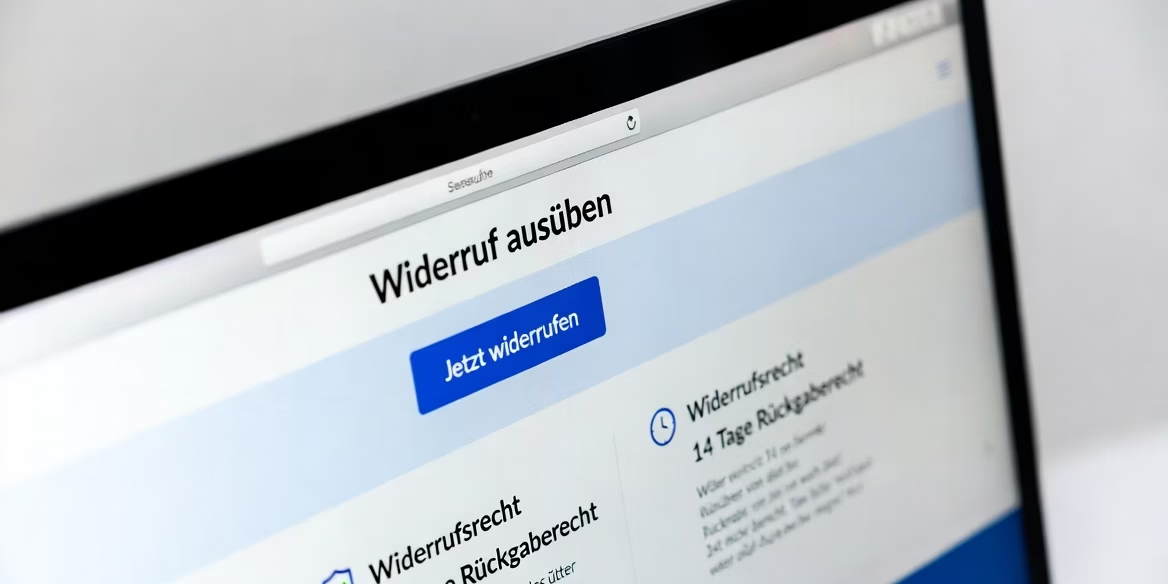
- A clearly visible cancellation page
- An unambiguously labelled cancellation button
- A structured form that does not require login
- A direct online cancellation option
- Automatic confirmation sent to the customer
- Technically reliable, traceable processing
The essential point is that the customer can cancel without unnecessary detours.
Conclusion
The Hanau ruling creates more flexibility, but does not remove the underlying obligations.
Additional cancellation routes are allowed; the statutory cancellation button remains the central requirement.
In practice, many Shopify and Lightspeed stores still do not fully meet these requirements.
A properly implemented process reduces legal risks while improving transparency and trust for customers.
Sources: section 312k BGB and Hanau Regional Court, 3 December 2025, 9 O 423/24 (German). Obtain qualified legal advice for your specific contracts; Lightport supports the technical implementation.